For years, personalization in direct mail meant adding a customer's name, changing a headline, or swapping out an image based on a demographic segment. While those tactics still have value, today's highest-performing campaigns go much further.
Modern personalization is about creating communications that reflect who the customer is, what they've done, when they're most likely to engage, and what action you want them to take next.
Retailers and agencies are increasingly using behavioral data, automated decision-making, and dynamic creative to build direct mail campaigns that feel relevant to each recipient—not just customized.
As customer expectations continue to rise, brands that rely solely on traditional variable data printing (VDP) risk falling behind competitors delivering more intelligent, timely, and personalized experiences.
Personalization Has Evolved Beyond Variable Data
Variable data printing remains the foundation of personalized direct mail, allowing marketers to customize names, addresses, images, offers, and messaging for individual recipients.
But true personalization doesn't stop with what appears on the printed piece.
Leading marketers also personalize:
- When the mail is sent
- Why the customer receives it
- Which offer is presented
- How the customer is expected to respond
- What happens after they engage
Instead of treating personalization as a design feature, successful brands view it as a strategic process that connects customer data, marketing automation, and print production into one coordinated campaign.
The result is communication that feels timely, relevant, and helpful rather than generic.
Behavioral Personalization Creates More Relevant Customer Experiences
Today's consumers generate valuable data every time they interact with a brand.
Whether they browse a product page, abandon an online cart, redeem a coupon, or make an in-store purchase, those actions provide insight into what they may need next.
Behavioral personalization allows marketers to respond to those actions with direct mail that supports the customer journey.
Common triggers include:
- Online cart abandonment
- Recent purchases
- Product replenishment reminders
- Loyalty milestones
- Website browsing activity
- Subscription renewals
- Lapsed customer re-engagement
- Seasonal buying habits
Rather than relying on broad audience segments, behavioral marketing focuses on individual intent.
When direct mail arrives shortly after a meaningful customer action, it becomes part of an ongoing conversation instead of another advertisement.
Personalization Includes Timing, Not Just Content
One of the most overlooked forms of personalization is timing.
Even the most compelling offer can underperform if it reaches the customer too early—or too late.
Advanced marketers carefully align mail delivery with customer behavior and buying cycles.
Examples include:
- Sending replenishment reminders before products run out
- Delivering seasonal promotions just before purchase windows open
- Triggering loyalty rewards after milestone purchases
- Mailing reactivation campaigns after a period of inactivity
- Following up on digital engagement with personalized direct mail
Timing transforms personalization from simply changing the message to delivering that message when it has the greatest chance of influencing a decision.
Decision Trees and Business Rules Make Campaigns Smarter
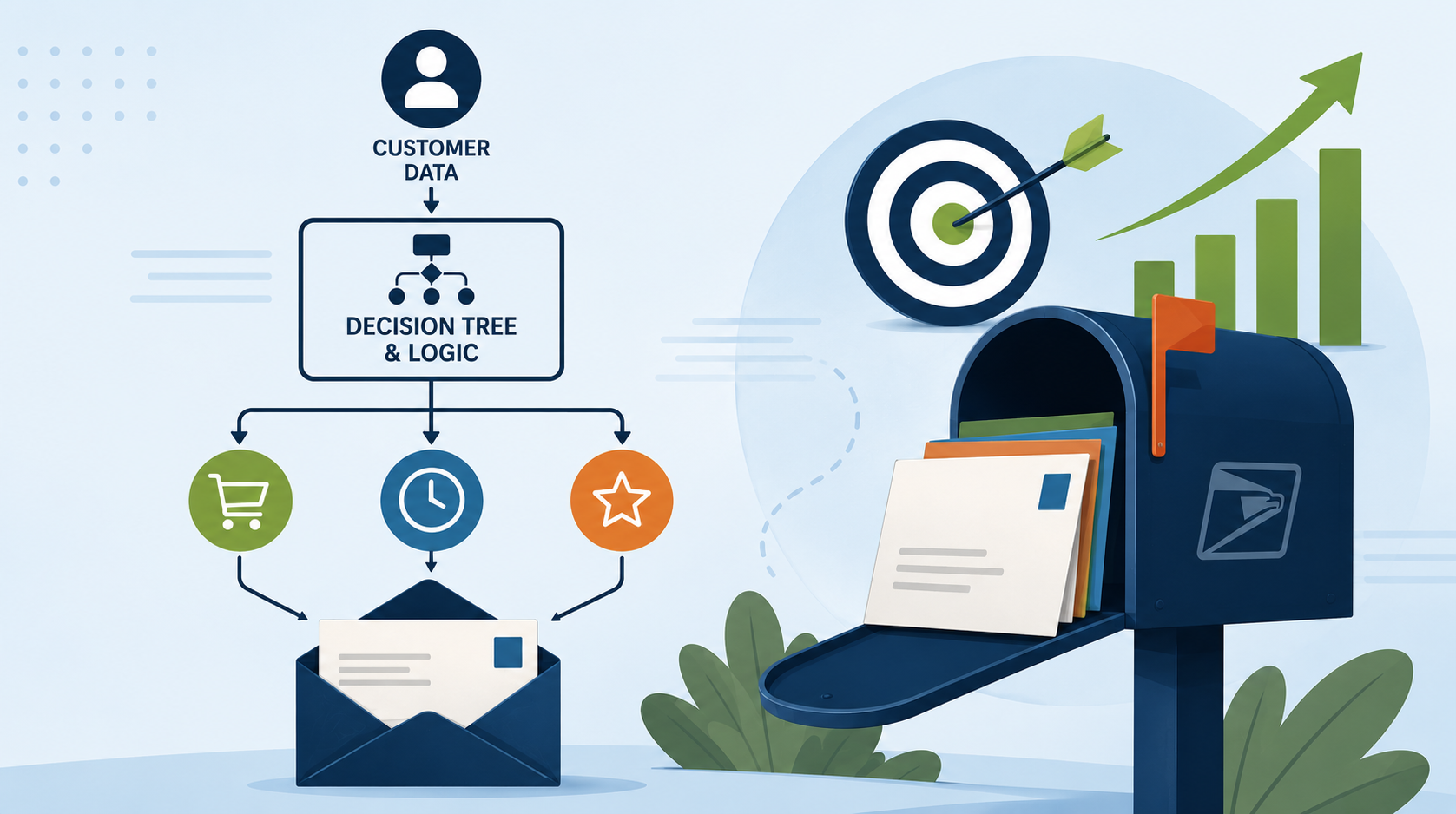
As personalization strategies become more sophisticated, many organizations rely on decision trees and logic-based workflows to automate customer communications.
Rather than creating a single campaign for every customer, marketers establish business rules that determine which version of the campaign each recipient receives.
For example:
- If the customer purchased within the last 30 days, send a complementary product offer.
- If they haven't purchased in six months, send a reactivation incentive.
- If they're a VIP loyalty member, provide early access to a promotion.
- If they're a new prospect, introduce the brand with educational content instead of a discount.
These automated decision paths help ensure every customer receives messaging appropriate for their relationship with the brand.
As customer data grows, this type of logic-based personalization becomes increasingly valuable.
Dynamic Offers Deliver Better Results Than Static Segmentation
Traditional segmentation divides customers into broad groups such as age, geography, or purchase history.
While useful, static segments often fail to capture what customers are actively interested in today.
Dynamic personalization adapts offers based on current customer behavior and business objectives.
A campaign might personalize:
- Featured products
- Promotional offers
- Discount levels
- Calls to action
- Nearby store locations
- QR codes
- Personalized URLs (PURLs)
- Landing pages
- Expiration dates
Instead of thousands of customers receiving the same message, every recipient receives the offer that's most relevant to their current stage in the buying journey.
That level of relevance often leads to higher response rates, stronger customer engagement, and improved return on marketing investment.
Scaling Personalization Creates Operational Challenges
Creating a handful of personalized mail pieces is relatively straightforward.
Producing hundreds—or even thousands—of unique versions across multiple campaigns is another challenge entirely.
Large-scale personalization often involves:
- Multiple customer data sources
- Frequent database updates
- Hundreds of creative variations
- Complex variable text and imagery
- Automated file generation
- Tight production deadlines
- Postal optimization
- Quality control for every personalized piece
Without strong operational processes, even well-designed personalization strategies can encounter production delays, data errors, or inconsistent output.
That's why production expertise becomes a competitive advantage—not just a manufacturing function.
How PrintComm Helps Brands Scale Personalized Direct Mail
Executing highly personalized direct mail campaigns requires more than variable printing capabilities. It requires operational expertise, reliable workflows, and the ability to manage complex production without sacrificing quality or speed.
PrintComm partners with retailers, agencies, and enterprise marketing teams to simplify large-scale personalization through:
- Complex variable data production
- Logic-based campaign workflows
- Multi-version creative management
- Dynamic data integration
- Automated production processes
- Postal optimization
- Quality control across every personalized piece
- Scalable execution for campaigns of any size
Whether you're launching triggered lifecycle campaigns or managing millions of personalized mail pieces annually, PrintComm helps ensure every customer receives the right message at the right time—with the consistency and accuracy modern marketing demands.
Ready to Move Beyond Basic Personalization?
If your direct mail program is still relying primarily on traditional variable data printing, there may be opportunities to deliver more relevant experiences and improve campaign performance.
PrintComm helps brands implement advanced personalization strategies—from behavioral triggers and decision-tree logic to complex variable production and operational optimization—so campaigns can scale without sacrificing quality or efficiency.
Contact PrintComm today to learn how we can help you build smarter, more personalized direct mail campaigns that deliver measurable results.